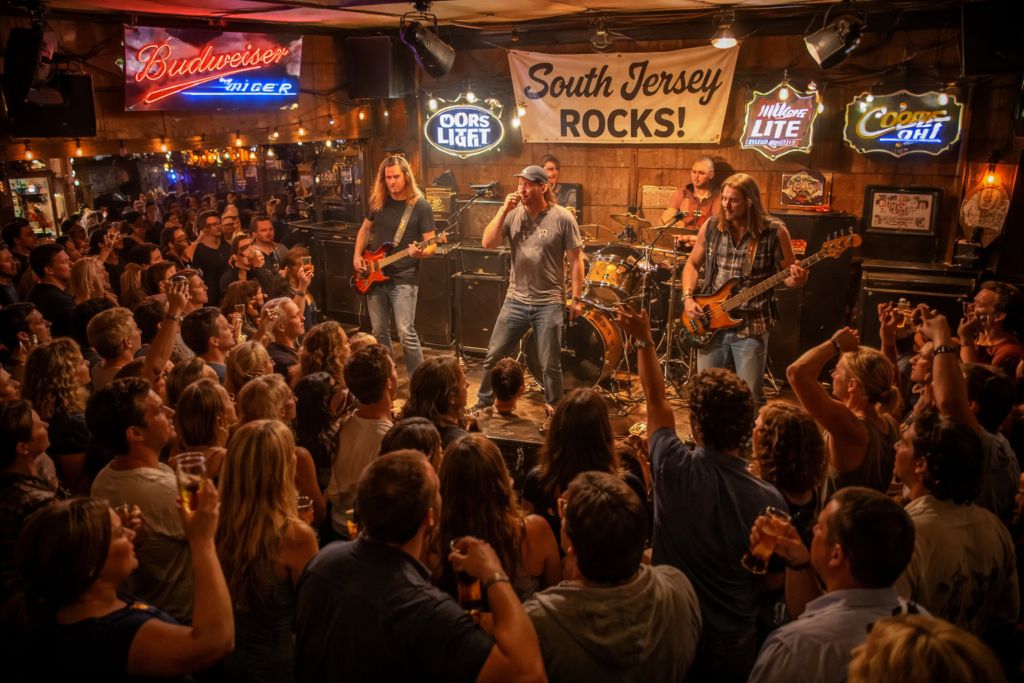
A love letter to the sticky floors, the Marshall stacks, and the nights we never wanted to end.
There was a very specific ritual to a great South Jersey night out, and if you lived it, you remember every detail…
You’d get ready too early, argue about where to go for exactly fifteen minutes, and pile into somebody’s car smelling like Drakkar Noir or Cool Water. You’d park somewhere inadvisable, pay a cover that seemed outrageous at the time and laughably cheap in retrospect, and push through a door into a wall of sound and heat, bodies and sometimes musty odors. By the third song you couldn’t hear the person next to you and didn’t care. By midnight you’d learned every word to something you’d never heard before. By last call you were sweaty, hoarse, and completely unwilling to go home.
That was South Jersey in the 1990s and 2000s. No arena. No premium seating tier. No app required. Just a band, a bar, and a hundred people who showed up because a great band was playing.
This is the story of those places, and the bands that made them matter.
The Shore Circuit: Where Summer Never Really Ended
KIX McNutley’s, Sea Isle City (The Institution)
If you grew up going down the shore in South Jersey during this era, KIX was a rite of passage. A landmark at JFK Boulevard and Landis Avenue in Sea Isle City, KIX had been hosting live music and mayhem since the late 1960s. By the time the 1990s arrived, it had already been forged by decades of summer crowds and was operating as one of the most reliable live music destinations on the entire South Jersey coast.
What made KIX work wasn’t just its size (though it grew over the years into a six-bar complex with an enormous capacity), over the years into a six-bar complex with an enormous capacity it was the consistency. Night after night, summer after summer, KIX delivered live bands that knew exactly what their audience wanted: high-energy rock and roll, a dash of nostalgia, and enough muscle in the rhythm section to shake the floor. The crowd was a cross-section of South Jersey summer culture: lifeguards, locals, college kids home for the season, families who’d been coming to Sea Isle for three generations.
In the 1990s, KIX was ground zero for cover bands doing what cover bands in South Jersey did best: playing the songs everyone already knew and making them feel brand new. The setlists evolved with the decade: early 90s grunge sat alongside Springsteen staples, with enough classic rock to keep the older crowd from heading to the parking lot early. By the 2000s, KIX had become a destination for some of the most polished regional acts on the circuit, including tribute acts that could fill a room on a Thursday night in July with the same reliability as a national tour.
What’s There Now: KIX McNutley’s still operates in Sea Isle City, still going strong with live entertainment every summer. It’s one of the true survivors, a testament to the durability of doing things the right way for a very long time.
The Ocean Drive (The OD), Sea Isle City (The Dive With a Soul)
If KIX was Sea Isle’s main stage, The Ocean Drive, universally known as The OD, was its beating heart. A classic Jersey Shore dive bar in the most affectionate sense of the phrase: dark, loud, cash-only, and incapable of pretension.
The OD’s legendary Saturday No Shower Happy Hour was something that had to be experienced to be believed. The concept was exactly what it sounded like: show up from the beach, salt in your hair, sand between your toes, and nobody is going to judge you. It created a midday ritual that felt completely unique to the Shore, an afternoon drinking session that extended seamlessly into a live music night, where the same people who’d been on the beach at noon were still dancing at midnight.
The Sunday Jam was equally iconic. Week after week, bands that knew how to read a summer crowd packed the room with people who were in no hurry for the weekend to end. There was always a certain desperation to a Sunday night at The OD in the 1990s, the feeling that if the music stopped, summer might too.
What’s There Now: The OD underwent a refresh in 2012, adding the Sandbar & Grill next door for a more casual outdoor experience. It remains one of Sea Isle’s most beloved institutions. It’s still there. It’s still loud. The Sunday Jam lives on.
LaCosta, Sea Isle City (The Late-Night Anchor)
LaCosta was a fixture on the Sea Isle live music circuit through the 1990s and into the 2000s, the kind of bar where a band could show up and find an audience that had been pre-warmed by the rest of the strip and was ready to stay for the whole set. The Fuzzy Bunny Slippers, one of the most beloved bands on the South Jersey Shore circuit, made LaCosta one of their regular stops, and for good reason: the crowd there had a specific energy, ready for something a little harder-edged than the average Shore bar could deliver.
What’s There Now: LaCosta was rebranded around 2018, but eventually closed in 2021. In 2024 it was torn down to be replaced by a hotel and housing unitis.
Dreams, Carneys & The Washington Street Mall, Cape May (The Southern End)
Cape May was, and remains, its own world within South Jersey. The Victorian architecture, the tourist-season rhythm, the sense that you’d traveled somewhere slightly outside of time: all of it gave the Cape May music scene a distinctive character that set it apart from the more raucous Shore towns to the north.
Dreams was one of the premier live music stops in Cape May during the 1990s, a bar that drew the bands willing to make the drive to the southernmost tip of New Jersey and play for a crowd that would reward them for it. Carneys was another staple, less formal, more neighborhood, the kind of bar where locals hung out on a Wednesday night and visiting bands found a genuinely receptive audience.
But the venue that occupied a special place in the memory of everyone who experienced it was a small room at the end of the Washington Street Mall.
The Shire, Cape May (The Greatest Dive You Never Heard Of)
The Shire was a dive bar. This needs to be said plainly and lovingly. The décor was an afterthought. The food wasn’t the point. There was nothing about the physical space that would make you linger if the music had stopped.
But the music never stopped, and it was extraordinary.
The Shire was home to Steve Green and the Elevators and that alone would have been enough. Green, a musician who had toured with the great Lou Rawls before settling into the Cape May scene, brought a genuine, floor-shaking funk and soul sensibility to a room that was barely big enough to contain it. The Elevators weren’t playing background music. They were playing like every set was the one that mattered most, because they were. Audiences who wandered in expecting cover band South Jersey bar rock were stopped cold and converted on the spot.
People drove from the northern reaches of South Jersey, Cherry Hill, Voorhees, Gloucester Township, specifically to see the Elevators at the Shire. That doesn’t happen for many bars, in many places, at any time. It happened at the Shire because Steve Green and his band were that good.
“If you wanted a shot, a beer, and some of the best music around,” one Cape May native later recalled, “it was the Ritz-Carlton.” That’s exactly right.
What’s There Now: The Shire is gone. The Washington Street Mall has evolved, and the raw intimacy of that room exists only in the memories of the people who were there. Steve Green continued as a studio musician in Philadelphia and remains active in the area music scene.
Kitty’s, North Wildwood (The Main Stage of the Wildwood Strip)
The Wildwood strip in the 1990s was its own phenomenon: a multi-block live music ecosystem running from North Wildwood down through Wildwood proper that operated every summer weekend at a level of sustained intensity that was hard to find anywhere else on the East Coast.
Kitty’s in North Wildwood was one of the anchors. The stage was low, the ceiling felt lower, and on a peak summer weekend the crowd stretched to the walls and out toward the door. Kitty’s was where the Shore circuit’s best cover bands came to prove themselves, and not because of the prestige but because of the audience. A Wildwood crowd on a Saturday night in 1994 was not forgiving of a mediocre set. They came to move, and if you didn’t make them move, they found somewhere else to be.
Funnybone, the most celebrated cover act on the Cape May County shore circuit in the early and mid-1990s, made Kitty’s one of their signature stops. Their setlist tracked the exact evolution of the decade: Pearl Jam, Stone Temple Pilots, Nirvana, Alice in Chains, Soundgarden. They played what the room wanted, and what the room wanted in 1993 was grunge. As one band member later put it: “We played to the girls. Where the girls are, the guys will follow.” The philosophy was unsentimental and completely correct. Funnybone was everywhere in those years, building a massive following through sheer relentlessness on the circuit.
The Playpen & Jimmy’s, Wildwood (The Heart of the Strip)
A short geography lesson: the Wildwood strip in the 1990s wasn’t a single destination, it was a route. You started somewhere, you ended somewhere else, and in between you moved from room to room based on who was playing and how many people were packed inside.
The Playpen was an essential waypoint on that route. It held its own against the heavier competition by booking bands that could hold the room: cover acts that knew how to read a Shore crowd and play long enough for the night to genuinely build. The Playpen wasn’t trying to be something it wasn’t. It was a bar with a stage and a license, and it delivered on that promise with admirable consistency.
Jimmy’s was the room that tilted harder toward the alternative generation. As the 1990s progressed and the grunge-inflected crowd aged into their mid-twenties, Jimmy’s kept pace with the evolving taste by booking bands that could pivot from Soundgarden to Springsteen to some Pearl Jam deep cut, which was exactly what was required to survive on the Wildwood circuit past about 1996.
What’s There Now: The Wildwood strip contracted significantly in the real estate boom of the early 2000s, when over 100 Doo-Wop era properties were demolished for condo development. Many of the 1990s Shore clubs, including Kitty’s, The Playpen, and Jimmy’s, are gone. The strip still has bars and live music, but the specific ecosystem of the 1990s club scene is a memory. Which makes it, in the way of all lost things, even more vivid to the people who were part of it.
The Red Bull, North Cape May (The Underdog Standout)
Not every essential venue announced itself with neon and a velvet rope. The Red Bull in North Cape May was a smaller, quieter operation, the kind of bar where the regulars knew each other by name and the bands knew the regulars by their drink order.
What the Red Bull had was atmosphere. The proximity to the water, the scale of the room, the sense that you’d found something slightly off the beaten path, all of it adding up to a venue where live music felt more intimate than almost anything else on the southern Shore circuit. For bands like Funnybone and Fuzzy Bunny Slippers, the Red Bull was a reliable stop on a circuit that stretched from Somers Point down through Sea Isle and Cape May, and they played it accordingly, knowing that the room rewarded connection over volume.
Somers Point Waterfront Bars (The Legacy Neighborhood)
The ghost of Tony Mart’s hovered over Somers Point’s bar scene throughout the entire 1990-2010 era. The original club had closed in 1982, but Bay Avenue still drew live music crowds to the waterfront bars that filled the vacuum it left behind.
The venues that operated along the Somers Point waterfront in the 1990s and 2000s, various iterations of waterfront bars and deck establishments overlooking the Great Egg Harbor Bay, maintained the spirit of the old strip in a different key. The bands were booked to a similar template: regional acts who knew the Shore crowd, could play long sets, and understood that the sunset over the bay was competition and ally in equal measure. The point was never just the music. It was the night itself, the water, the warm air, and the feeling that summer was inexhaustible.
Carmen Marotta, Tony Mart’s son, began producing legacy concerts in Somers Point that eventually became the celebrated Concerts on the Beach series at Morrow Beach, tying the present directly to the past. But even before those more formal productions, Somers Point’s bar strip was alive with live music throughout this era.
Inland South Jersey: The Circuit That Never Made the Postcards
The Cherry Hill / Collingswood / Haddon Township Belt
The Shore gets most of the mythology, but South Jersey’s inland live music scene during the 1990s and 2000s was a real and vital thing. It just operated at a lower altitude, in the restaurants and bars of Camden County’s suburban towns that didn’t have an ocean view to help set the mood.
Cherry Hill, Haddonfield, Collingswood, Westmont, Marlton: the Camden County suburb corridor was full of bars booking live music on Friday and Saturday nights throughout this era. These weren’t glamour gigs. They were the backbone of the working musician’s calendar: steady work, regular crowds, the opportunity to build a following in the communities where the audience actually lived.
The cover band circuit in this area was its own world. Acts could build enough of a following in the inland South Jersey bar scene to sustain themselves year-round, supplementing the summer Shore work with consistent suburban bookings that kept bands working through the off-season. Many of the acts that were stars of the Shore circuit in July would be playing to the same loyal fans in a Cherry Hill sports bar in November, and the relationship between band and audience was the richer for it.
Collingswood, which began a significant downtown revival in the late 1990s that accelerated through the 2000s, became increasingly important as a live music destination. The borough’s growing restaurant and bar scene on Haddon Avenue drew crowds who wanted something more sophisticated than a Shore bar but more intimate than a casino showroom, and the live music scene there grew to fill the need.
The Bands: A Generation Defined by the Setlist
1990–1995: Grunge Arrives at the Shore
The early 1990s were a pivotal moment for South Jersey’s cover band ecosystem. The spandex-and-hairspray era of the late 1980s was giving way, almost overnight, to something rawer. Nirvana’s *Nevermind* dropped in September 1991 and within months the Wildwood clubs sounded different. The bands that survived were the ones that read the room fast.
Funnybone was the gold standard. A Cape May County circuit fixture who became one of the most popular live acts on the entire South Jersey Shore, Funnybone built their brand on a simple philosophy: play what the crowd wants, play it better than anyone else, and never stop moving. Their setlist tracked the exact pulse of the early-to-mid 1990s played with genuine conviction and enough athletic energy to keep a packed room at Kitty’s or Jimmy’s moving from the first song to the last. The singer climbed on bars. He swung from whatever was available. Funnybone understood that at a Shore club on a Saturday night, the band was the show, and the show required commitment.
Fuzzy Bunny Slippers, formed by Wildwood lifeguards (which may be the most South Jersey sentence in this entire article), were perhaps even more beloved than Funnybone in their prime. Formed by Mike Burke and fellow lifeguards in Wildwood, the Fuzzies hit the circuit at a moment when the mid-90s eclectic expansion of rock was allowing bands to mix genres in ways the 80s bar scene never would have tolerated. Their catalog blended hard rock, reggae, ska, and a hip-hop medley that was twenty minutes long and somehow worked. They played Dreams, The Playpen, Jimmy’s, LaCosta in Sea Isle and anywhere that could accommodate their particular combination of high energy and good humor. At their peak they were drawing audiences from Virginia to Vermont, making them easily one of the most successful South Jersey original/cover hybrids the region produced in this period.
Other essential names on the Cape May county circuit in these years:
LeCompt, Crystal Roxx, Yclept, and Black Friday were all part of the early-to-mid 90s Shore ecosystem, bands that regulars still name with the same nostalgia they reserve for the venues themselves, acts that filled the Shire and the Wildwood clubs and made the summer feel complete.
Steve Green and the Elevators occupied a separate and sacred category. Green’s band was the soul of the Cape May scene in a way that transcended the cover band circuit entirely. Where most Shore acts were bringing national sounds to local rooms, the Elevators were creating something genuinely their own: a funkiness and depth that made their sets at The Shire into events. The band had a spiritual center that the hairspray-and-grunge circuit couldn’t touch.
1995–2000: The Ska Moment, the Jam Band Surge, and the Scene at Its Peak
The second half of the 1990s were, by most accounts, the peak of the South Jersey live music bar scene. The Shore circuit was fully mature. The inland suburban bars had found their footing. Ska had its moment: Mighty Mighty Bosstones, Reel Big Fish, No Doubt, and the posthumous Sublime craze infected virtually every South Jersey band with at least a horn section and a checkered pattern or two.
The jam band wave was equally significant. Dave Matthews Band, Phish, Blues Traveler, and the Grateful Dead-adjacent jam world had a devoted South Jersey following, and the bars that could accommodate a three-hour set with extended instrumental passages found devoted audiences who came back week after week for the same experience. The Shore circuit expanded its definition of what a bar gig could look like.
The original music scene was also deepening. Bands writing their own songs, influenced by the Philadelphia indie and punk underground just across the Delaware River, were finding venues willing to book them in smaller bars, in Collingswood, all-ages shows in VFW halls in Deptford and Vineland, the occasional late-night slot at a Wildwood club willing to take a chance on something that wasn’t a cover set.
The Early November began forming in this period out of Hammonton, Atlantic County, a band whose mid-tempo emotional rock would eventually achieve national reach through Drive-Thru Records. They weren’t a bar band in the Shore circuit sense, but they were deeply, genuinely South Jersey: their music carried the specific melancholy of watching summer end from a barrier island parking lot, the suburban loneliness of Camden County side streets in October.
2000–2005: The Internet Age Arrives, but the Bars Hold On
The early 2000s brought changes that would, over the long term, reshape how music was found, consumed, and experienced everywhere, South Jersey included. Napster had happened. Broadband was spreading. The old model of discovering music only from radio, word of mouth, and live performance was beginning to crack.
But you wouldn’t have necessarily known it on a Saturday night in Sea Isle City in 2002. The Shore circuit was still going strong. KIX was packed. The OD was running the Sunday Jam. The bands had adapted to the new musical landscape: emo, post-hardcore, early-2000s pop-punk, and the continued dominance of jam and classic rock all coexisted on a circuit that was nothing if not flexible.
The inland suburban scene was arguably more active during this period than it had ever been. A generation of South Jerseyans who had grown up going to Shore bars now lived in Cherry Hill, Voorhees, and Moorestown with disposable income and a genuine desire for the kind of community experience that live music in a bar provides. The Friday night cover band at a Haddon Township or Collingswood bar became a genuine social institution for the 25-to-40 demographic.
The Wildwood clubs were thinning, though. The real estate boom was beginning to reshape the strip. Some of the 1990s Shore clubs had already closed, and by the mid-2000s the specific ecosystem of the Kitty’s-and-Playpen era was effectively gone. The music hadn’t disappeared. It had moved, distributed itself across the broader bar scene in ways that made it harder to find in concentrated form.
2005–2010: The Last Great Run
The second half of the 2000s were, for the South Jersey live music bar scene, a long and occasionally beautiful coda.
The economy went to pieces in 2008, which took a toll on bar and music spending everywhere. But in the years before that, and even in the years after, South Jersey’s bar music scene showed remarkable resilience. The Shore circuit had reinvented itself around whatever the current crop of regional bands were playing. The suburban bars had a steady audience. The music was still happening.
A new generation of original bands was working the region: young acts influenced by the post-punk revival (The Killers, Franz Ferdinand), the indie rock explosion (Arcade Fire, Modest Mouse), and the emo and post-hardcore scene that had been building in the Philadelphia suburbs for a decade. These bands played smaller rooms: house shows and bar back rooms. They weren’t on the main Shore circuit, but they were building something real.
The tribute band phenomenon, which had been growing since the 1990s, reached a kind of apex in the late 2000s. South Jersey produced some genuinely excellent tribute acts during this period: bands dedicated to Springsteen, Bon Jovi, Tom Petty, U2, and virtually every other major act of the rock canon who could fill a room on a Saturday night. These weren’t impersonators going through the motions. The best South Jersey tribute acts were staffed by serious musicians who had grown up playing the Shore circuit and knew how to deliver a complete, professional performance.
By 2010, the landscape had been reshaped. The Shire was gone. Many of the 1990s Wildwood clubs were gone. The OD had updated. KIX had expanded and adapted. The inland bars had come and gone in waves, as bars always do. The bands had turned over. The people who had been twenty-two years old in 1993 were now in their late thirties, and they carried the memory of those nights with them the way people carry the things that actually mattered.
The Sound of South Jersey
What made the South Jersey live music bar scene of 1990 to 2010 distinctive wasn’t any single venue or any single band. It was the particular combination of geography, culture, and community that the region produced.
South Jersey was working-class and suburban at once. It had the Shore’s blue-collar summer culture and the Camden County suburb’s aspirational professional culture, and the live music scene served both simultaneously. It was close enough to Philadelphia to be influenced by the city’s rich musical history without being defined by it. It was connected to the larger New Jersey rock tradition of Springsteen, Bon Jovi, and the Shore Sound, without being trapped in its shadow.
The bands understood their audience. The best acts on the South Jersey circuit weren’t just playing music. They were providing an experience that was social and emotional and physical all at once, the experience of being in a room full of people who all know the words. That’s a specific and irreplaceable thing, and South Jersey in this era did it as well as anywhere.
The venues are largely gone. The nights exist now as stories people tell when they run into each other somewhere and someone says remember when and suddenly it’s 1996 again and the band is playing the third song and the night hasn’t even started yet.
South Jersey played loud, right up to last call. That’s worth remembering.
If you were there, if you remember the bands, the bars, the specific smell of a Wildwood club on a Saturday night in August, we want to hear from you. The South Jersey live music story is still being written, one memory at a time.

Leave a Reply